
Regulation Can Feel Like a Full-Time Goalie Job, where you’re blocking shots all day but never taking one.
Compliance audits. Change controls. Safety cases.
Meanwhile, customers expect faster restoration, cleaner energy, and smarter everything.
But if you only play defense, innovation debt builds up fast. And suddenly, even small moves feel risky.
Here’s the playbook I use with utility and energy teams to flip the script and build speed without breaking what matters.
The Trap: Innovation Debt
Innovation debt doesn’t happen all at once, it’s what accumulates when good ideas stall behind approvals, integrations, and “come back next budget cycle.”
So, it creeps in every time someone says “let’s table that for next year” or “we can’t touch that system yet.”
You’ll know it when you see:
- Pilots that never graduate to make it out of the sandbox
- Tools that don’t talk to each other
- Security that’s more manual paperwork than protection via real controls.
- Projects that can’t survive a rate case or fall apart the minute an audit hits.
You don’t fight that by moving recklessly or going rogue. You fight it by designing speed with safety into the architecture from day one.
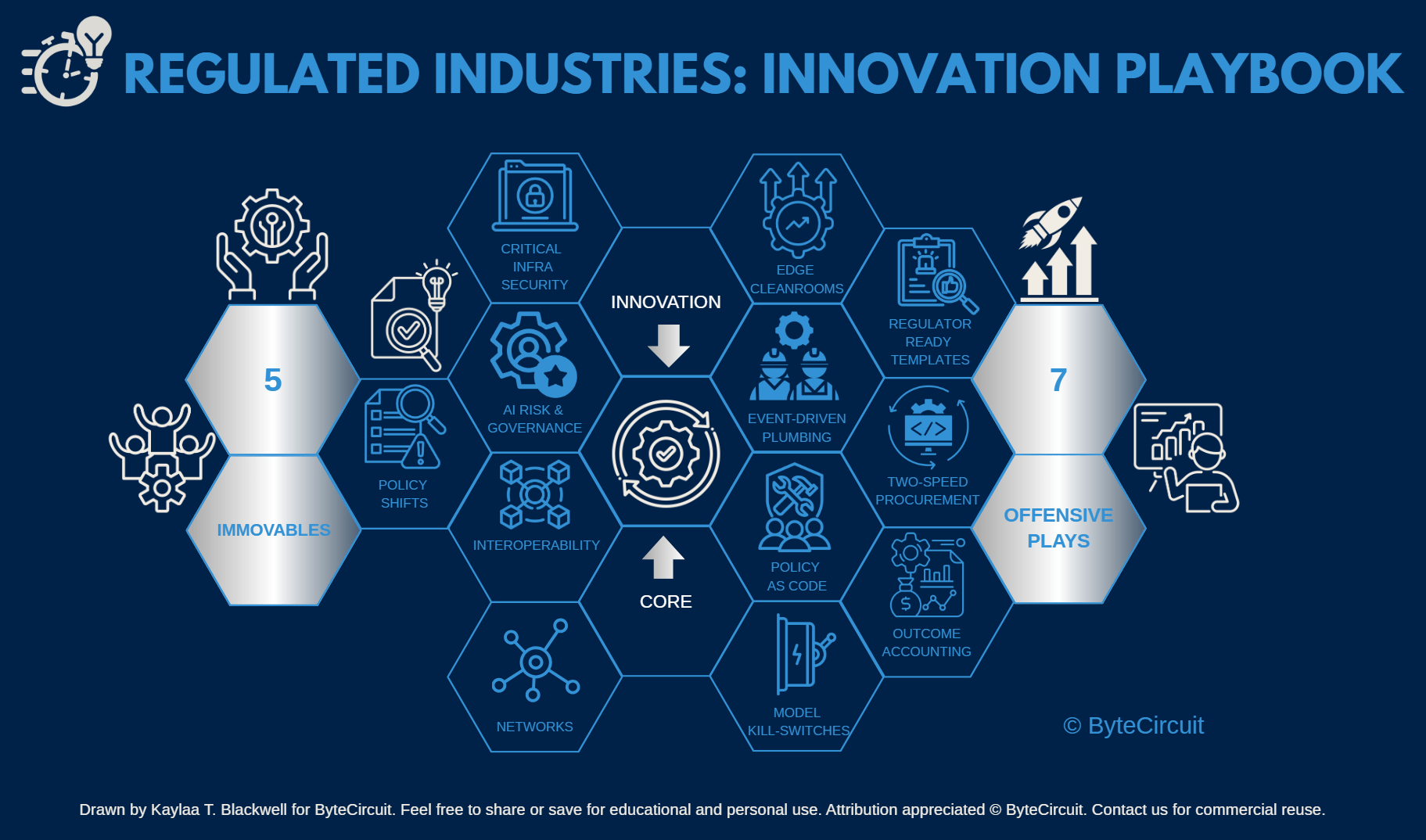
Design for the Five Immoveables
You can’t negotiate gravity. In regulated environments, there are certain forces you must design and build around…so treat them as constraints, not obstacles.
🛡️ 1. Critical Infrastructure Security
Use frameworks that make “secure by design” provable, not just lip service. For grid ops, that means North American standards like NERC CIP for critical cyber assets and IEC 62443 for layered defense across OT. Map your controls like you mean it and don’t try to wing it.
📊 2. Data Governance and AI Risk
Treat AI like infrastructure, not magic dust. Use the NIST’s AI RMF (NIST AI Risk Management Framework) to document context, risks, and kill-switches that you can actually pull. That’s how you defend when models drift and how you pass the next audit without drama.
🔗 3. Interoperability You Can Live With
Skip the rip-and-replace trap. Use open telemetry standards like IEC-61850, DNP3, OPC UA, and event-based flows that bridge OT to IT. IEC-61850 in substations, DNP3/OPC UA at the edge, event streams into your data platform. Interop is not optional, it’s your futureproofing, because it’s how you ship changes safely without ripping and replacing every time.
⚖️ 4. Market and Policy Shifts
Policies like FERC 2222 are changing how and where power flows. FERC Order 2222 enables aggregated DERs to participate in wholesale markets, which means your systems need to plan, schedule, and settle around resources you don’t fully control. If your systems can’t flex around DERs, forecasts, and settlements, you’re already behind. So, you need to design like that future has already arrived.
🌐 5. Network as a Control Surface
Latency and resilience are not “nice to haves” when you’re working with DERs, dispatching field crews, or coordinating storm response. That’s why many utilities are moving to private LTE/5G, and field-area networks to keep critical traffic deterministic and local. The network is the system now.
Seven Offensive Plays That Actually Ship
These aren’t just ideas…they are strategic plays that actually work when you’re stuck in regulated reality but still need to deliver.
🧩 1. Private Spectrum and Edge “Clean Rooms”
Use private LTE or 5G for predictable connectivity to keep critical workloads close to assets and crews. Then run analytics at the edge so ops can continue even if backhaul falters or the cloud goes dark. Document the control envelope and fail-safe logic behavior for audits. So you are ready when the auditors ask and they will.
🧩 2. Event-Driven Plumbing
Push OT data into IT through secure gateways and event streams. This lets you skip the one-off integrations and gives you the ability to add new use cases without new point-to-point integrations every time. Therefore, your ADMS, WFM, EAM, MDMS, and data platform stay loosely coupled. This flexibility allows you to rewire use cases and flows, not entire systems, when market and policy shifts.
🧩 3. Policy as Code
Map NERC CIP and IEC 62443 compliance controls to automated checks in CI/CD pipelines, infrastructure as code, and runtime guardrails. Let your system generate its own evidence while it runs, not only during once-a-year scrambles.
🧩 4. Kill-Switch Model Lifecycle
Every model needs a purpose, lineage, performance threshold, rollback plan, and a real operator button to shut it down or disable it. Feed drift metrics into change management so risk reviews are continuous, not quarterly theater…otherwise you’re just trusting luck.
🧩 5. Regulator-Ready Templates
Blueprint your architecture: Pre-package architectures, data flows, and threat models into repeatable blueprints. So that, when you propose a new program, you attach the template with controls, hazards, and built-in mitigation documented. That way, every proposal ships with the audit pre-check that’s already done and what still needs to be attended to by different stakeholders, which in turn helps shorten review cycles and makes your guidance more visible across different work teams.
🧩 6. Two-Speed Procurement
Long cycles keeps big platforms on multi-year strategic tracks. But use short cycles to spin up a fast lane for pilots with pre-approved vendors, outcome-based SLAs, and capped risk envelopes. Your pilots ship with guardrails and a path to production, not a one-off island. This prevents innovation from dying in the procurement queue.
🧩 7. Outcome Accounting
Forget vague KPIs. Track what boards and regulators actually care about:
- Minutes of outage avoided
- ETR accuracy
- DER hosting capacity
- Truck rolls eliminated
- Methane leaks detected
- Safety incidents reduced
Tie outcomes directly to the plays that enabled them. That’s how you prove value.
Where the Rubber Meets the Road
These aren’t hypotheticals…they’re happening now. Here’s what offense looks like when theory meets the grid:
⚡ Storm Corridors
Stand up an edge pipeline that fuses AMI events, weather, and video into operational alerts. Push them over private LTE to crew tablets. Your control room sees damage patterns faster, and crews get turn-by-turn priorities that update as conditions change. That innovation enables audit-ready artifacts while geting the right people to the right place before calls flood the control room.
⚡ DER Orchestration
With FERC 2222 in play, keep in mind DERs are market participants and can be modeled as a first-class resource. Use event-driven scheduling and network-aware dispatch so your distribution constraints are respected, your grid doesn’t break when the market moves. And when markets call, you can respond without manual heroics.
⚡ Digital Substations
Modernize bay by bay. IEC-61850 process bus, hardened gateways, monitored baselines and attested firmware. Security and operability go up together when you treat the substation as a living system, not a museum piece.
💡 The ByteCircuit Perspective
📌 Download: ByteCircuit Innovation Playbook Two-pager Checklist for Regulated Industries
A few more words on “innovation debt”
You can measure it. So start with four simple metrics:
- Time to safe pilot: from idea to controlled field test.
- Policy coverage: percent of controls enforced automatically.
- Interoperability score: number of new use cases shipped without new point-to-point integrations.
- Regulator cycle time: days from submission to approval on repeated blueprint patterns.
If those improve quarter over quarter, you are playing offense.
Your 30-60-90 Plays
30 days
- Name the five immovables for your org.
- Pick one use case where latency, safety, and value are obvious.
- Stand up an event stream from OT to your data platform with read-only scope.
60 days
- Wrap the use case in a regulator-ready template.
- Automate two high-value controls as code.
- Define model kill-switch criteria if AI is involved.
90 days
- Put the pilot in the field with private or segmented connectivity.
- Report outcomes in real grid units.
- Start the next use case on the same plumbing.
🧩The bottom line
Play offense, not just defense. Regulation is a necessity, so is the need to move. But you don’t need to move recklessly. The most resilient orgs aren’t just the ones who play defense better. They’re the ones who build speed and safety into their networks, workflows, and governance stack.
Design systems that audit themselves. Design networks that can think.
And measure value in units that actually mean something.
Because when the pressure’s on, defense alone won’t save you.
You need offence plays that actually ship.
💬 What’s the immovable in your org that’s hardest to design around…and what would it take to finally work with it instead of against it?
🧩 Found this helpful? Dive deeper into hybrid architecture, AI alignment, tech strategy and leadership in our other articles.
♻️ Share it to help others connect digital strategy with operational impact.
👉🏽 Follow Kaylaa T. Blackwell and sign up for ByteCircuit newsletter for more no-fluff insights into strategic leadership, innovation, and building smarter, scalable systems—by design. That helps you move faster, and still sleep good at night.
📘 P.S. Want a no-fluff entry point into Python? Sign up here for early access and sneak peeks of Kaylaa’s upcoming book:
Crack the Code: Python Byte by Byte—A Playbook to Learning Python Fast Without Fear, Frustration, or Tears.