
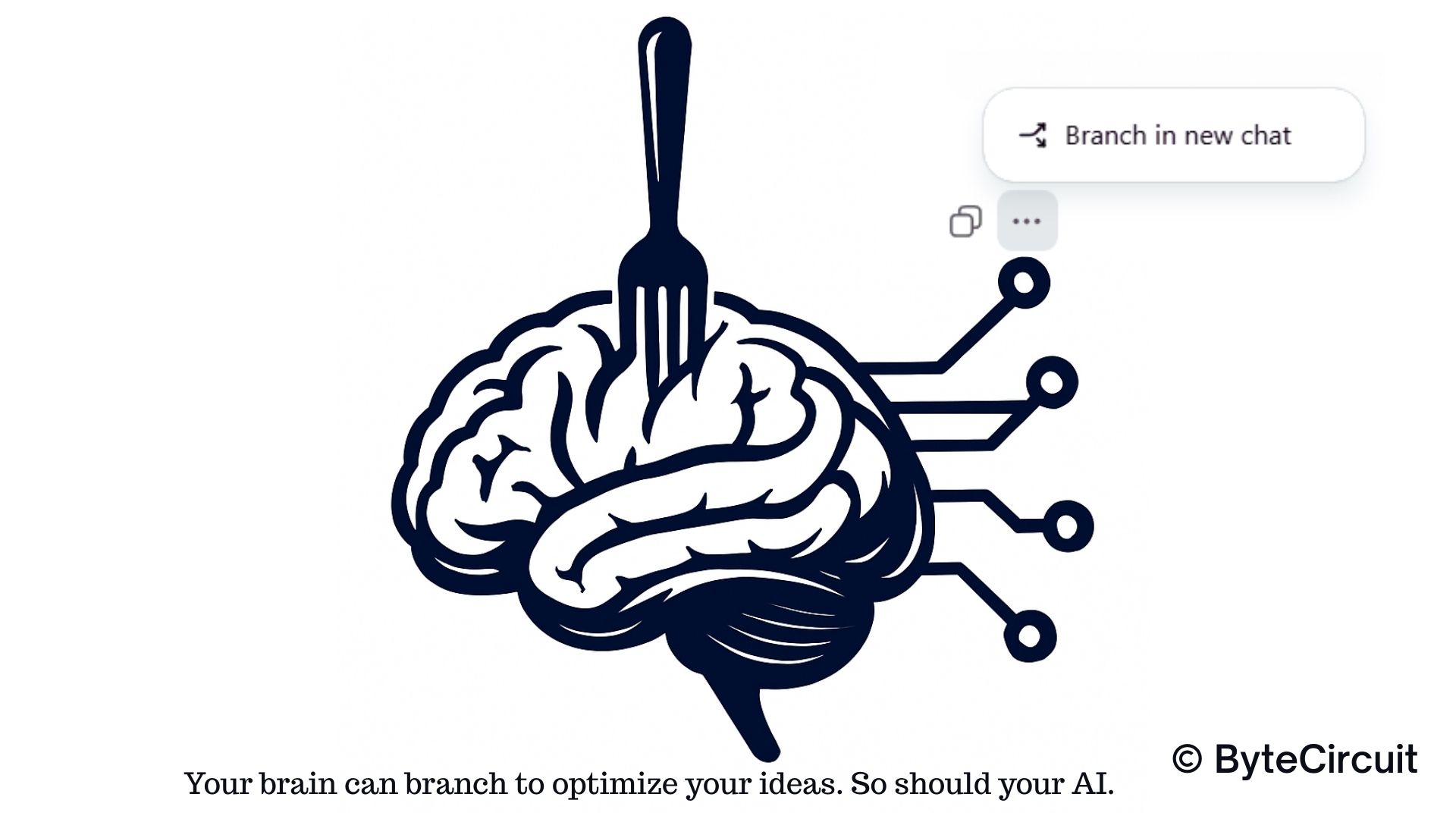
OpenAI this past Thursday introduced something users have been requesting for years: the ability to branch ChatGPT conversations mid-thread like a brain fork. With a single click, you can now create a new path from any message in the chat without losing your original context.
Hover over a message. Click “More actions.” Select “Branch in new chat.” From there, a duplicate thread opens, picking up from that exact moment.
Why this matters
It may sound simple. But for anyone doing serious work → strategy, copy, research, concepting, design, planning…it changes the rhythm of how you think with AI.
From Overwrite to Option Set
Linear chats force you to erase. Branching allows you to expand.
Until now, if you wanted to take a conversation in a different direction, you had two options:
• Rewrite your last message and lose what came before
• Start a brand new chat and retype your context from scratch
That setup kills momentum. Because you hesitate to experiment. You lose flow.
Now? You branch. You preserve. You compare.
You can explore tone shifts, dive into edge cases, or run variations without disrupting your original line of thought. So, one chat becomes a map of possibilities.
What this unlocks now
This update clears mental bandwidth, not just saves time.
It gives structure to the way real-world problem-solving actually happens — through exploration, side-by-side comparisons, and second chances without friction.
AI tools like ChatGPT already support multi-threaded thinking. Branching just makes that power visible and usable.
📌 Think like a strategist:
→ Test competing approaches to the same customer challenge
→ Run a “what-if” variation before you commit
→ Keep your original thinking intact while exploring new leads
It’s a Git-style mindset applied to conversation. Fork, test, refine. Stay grounded in source.
This is the kind of shift that builds better habits.
Researchers have shown that linear interfaces increase cognitive load in complex workflows. So this is not a minor UX update. It’s a mental model upgrade.
What to Watch Next
While competitors like Claude and Perplexity already offered variations of this feature, OpenAI just turned a developer wish list into a mainstream UX moment — now native, visual, and frictionless for everyday users.
This shifts how teams, creators, and product thinkers will now use AI in practice.
That ripple effect is what matters.
This is no longer about AI being “helpful.”
It’s now about enabling serious thinkers to scale their own decision-making.
🧩The Bigger Picture
What’s starting to form goes beyond mere convenience or better AI tools…it’s better scaffolding for parallel thinking, which is a huge differentiator.
It’s also indicative of how AI will help the next generation brainstorm, think about alternatives concurrently, plan, and build.
Because when conversations can branch, thinking can evolve.
Branching moves AI from reaction mode to scenario mode.
That’s the upgrade.
It turns ChatGPT into a mental workshop…one where your best ideas don’t overwrite each other. Or become memory loss. Or become a graveyard of restarts.
Instead they grow side by side.
As architecture.
⚡ Question: Are you still treating AI like a chatbot…or are you ready to structure it like a system?
🧩 Follow Kaylaa T. Blackwell and subscribe to ByteCircuit for more tech + utility breakdowns that help you connect the dots.