
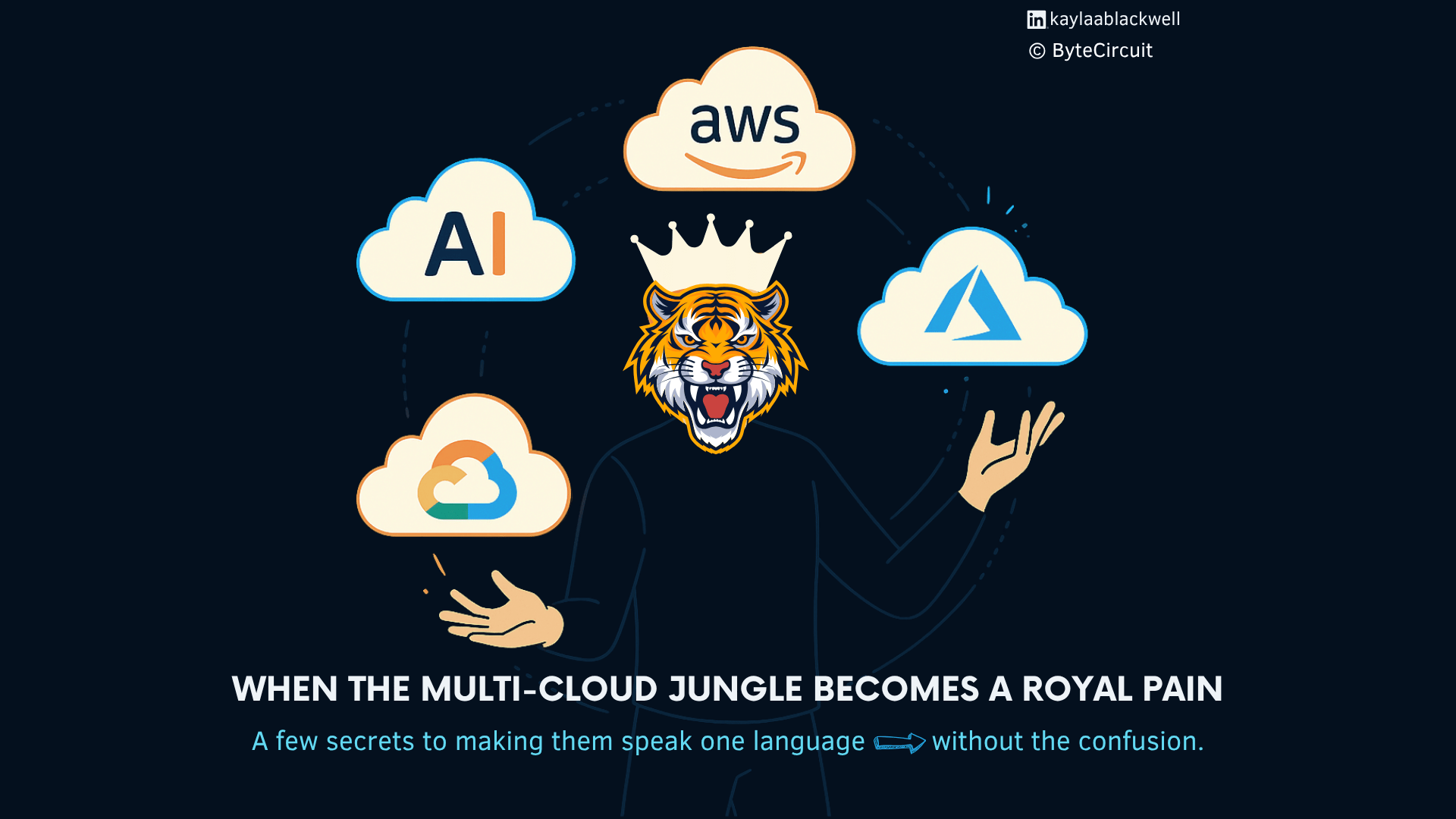
Cloud freedom sounds great…until every new platform adds another control panel, bill, and blind spot.
Multi-Cloud Without Maturity Is Just Chaos
Multi-cloud was supposed to mean flexibility. More choice, more control.
But what most companies actually have isn’t multi-cloud…it’s multiple clouds stitched together by hope and APIs.
Owning two or three clouds, like Google Cloud Platform (GCP), Microsoft Azure, and AWS doesn’t make you multi-cloud.
Running them as one does.
That’s the difference between a collection of environments and a true multi-cloud architecture.
One is convenient chaos. The other is designed coordination.
The gap we need to talk more about
True maturity means having shared identity, common policies, unified automation, and consistent observability.
But most organizations stall in the “lift and spread” phase, where each cloud runs independently with a copy-paste version of the same workloads.
When that happens, cost tracking starts fragmenting, latency creeps up, and compliance becomes a guessing game.
The result? Multi-cloud turns into multi-pain…or just a pain in the ass if you ask me or a few other key stakeholders.
Here’s how real multi-cloud maturity unfolds
1️⃣ Lift & Spread – Workloads scattered across clouds with no shared controls.
2️⃣ Federation – Central visibility, logging, and governance begin.
3️⃣ Automation – Infrastructure as code, policy as code, and service mesh unify operations.
4️⃣ Abstraction – Workload portability and dynamic scaling become real.
But after getting a jump start to get past the Lift & Spread stage, most enterprises stop again at stage two with Federation and pat themselves on the back for declaring victory.
But don’t put on your dancing shoes and start celebrating just yet, because that’s where the cracks start to form, especially when AI and data workloads enter the mix.
The AI & data twist
AI pipelines are heavy. They pull data, compute, and storage toward the same center of gravity.
So if your multi-cloud foundation isn’t mature enough, every new AI workload drags you deeper into silos, not freedom.
Data egress bills rise. Training time slows. Governance slips.
That’s usually the point where teams start scrambling for tools instead of strategy.
But tools don’t solve chaos…how you use them does.
🧩Terraform helps by making infrastructure portable through code, letting you define, deploy, and manage resources across GCP, AWS, and Azure the same way.
🧩Anthos extends Kubernetes management across environments, giving a single pane to control workloads on-prem and in any cloud.
🧩Crossplane builds on that by enabling cloud resources to be provisioned declaratively through Kubernetes itself.
🧩HashiCorp Vault secures secrets and credentials across environments so identity and access stay consistent no matter where workloads run.
When used together, or even selectively, these tools give structure to what otherwise becomes chaos.
They turn multi-cloud from a patchwork of unrealized dreams into a platform of symbiotic work that actually gets things done.
💡 The takeaway
The next wave of digital maturity won’t be about how many clouds you have…but how well they talk to each other.
💬 So what’s next for your org — real multi-cloud maturity or managed chaos?
🧩 Found this helpful? 👉🏽 Follow me, Kaylaa T. Blackwell and sign up for ByteCircuit newsletter for more insights into hybrid architecture, AI alignment, tech strategy and leadership in our other articles that help you connect the dots.
♻️ Share it to help others connect digital strategy with operational impact.
📘 P.S. Want a no-fluff entry point into Python? Sign up here for early access and sneak peeks of Kaylaa’s upcoming book:
Crack the Code: Python Byte by Byte—A Playbook to Learning Python Fast Without Fear, Frustration, or Tears.