
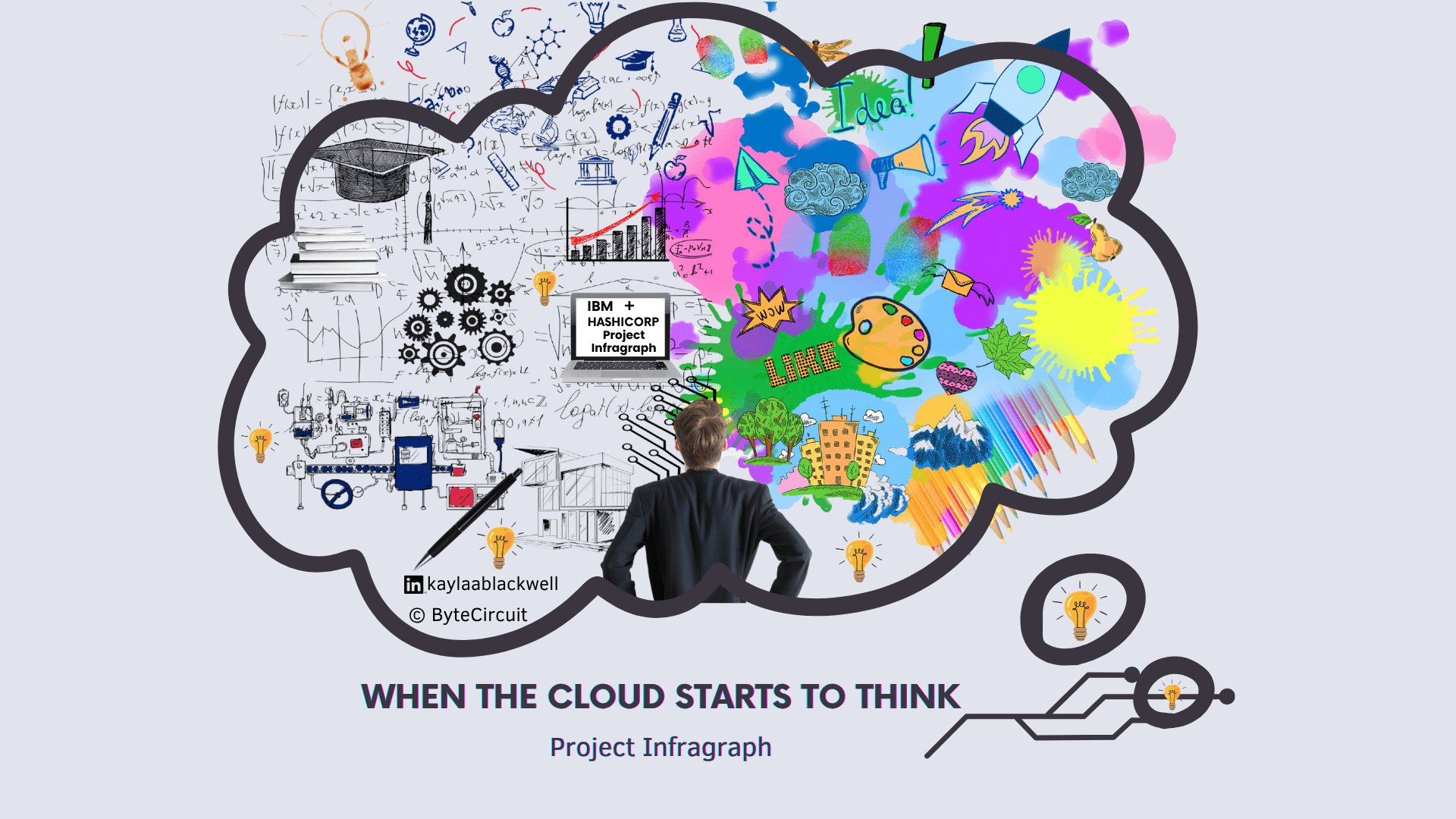
Automation gave us control. Until it didn’t.
What started as a way to simplify has become a maze of scripts, APIs, and pipelines we barely understand.
Automation got us far; it gave us speed and repeatability. But speed and scale are now outpacing our ability to understand what we’ve built.
Announced at HashiConf 2025, Project Infragraph might be the first true way out. HashiCorp’s next evolution attempts to make infrastructure self-aware enough to know why it’s doing what it’s doing. By building a unified relational infrastructure graph for hybrid and multi-cloud environments that links everything into a single system of records: resources, ownership, services, policies, and relationships → into one living knowledge system.
It’s also the foundation of what IBM and HashiCorp now call agentic infrastructure…AI-powered systems that can observe, reason, and act across complex IT estates in real time.
Not another pile of APIs cobbled together by scripts.
From Automation to Awareness
Think of it like this:
Terraform made infrastructure reproducible.
Vault made it secure.
Nomad made it schedulable.
Now, Infragraph aims to make it understandable.
Most automation today runs on rules and scripts.
And I know what you’re thinking…rules were made to be broken.
But that’s not where I’m going with this for now.
In this case, the problem isn’t the rules; it’s that they lack relationships.
When a pipeline fails or a policy breaks, systems don’t know why.
Infragraph’s knowledge layer builds those relationships.
It makes infrastructure self-aware enough to reason…tracing dependencies, ownership, and intent through a graph model that acts as its memory. By linking services, policies, and ownership data into one living map, it bridges what Infrastructure as Code (IaC) creates with what organizations actually need to understand…connecting provisioning to governance and real-time context.
That’s what makes this different. It gives automation context.
Giving infrastructure memory builds understanding that moves us far beyond task automation. So, when something breaks, it can trace cause and effect instead of just following a workflow.
Because it knows why something exists, not just what it does…what’s connected to what, what depends on what, and why it all matters.
It’s the first real step toward what IBM and HashiCorp call agentic infrastructure → automation that can explain itself → systems that reason through actions instead of just executing commands.
How It Changes the Game
Agentic infrastructure means your environment now understands how its parts fit together.
It doesn’t just automate…it learns and teaches back.
When you give automation context, you move from “run this” to “understand why we’re running this.”
That’s how you build trust back into the stack.
It also removes one of the biggest enterprise blind spots…fragmented visibility. By eliminating data silos and mapping every dependency, Infragraph turns disconnected cloud and on-prem environments into a single source of truth.
Imagine querying your entire hybrid infrastructure to instantly find which app teams are affected by a regional failure or policy change…that’s the level of precision this graph promises to bring.
- It understands which services depend on which teams, workloads, or costs…instantly mapping ownership and accountability.
- It can assess how a policy change ripples through your stack before you hit apply.
- It helps AI copilots reason through trade-offs like performance vs cost, risk vs reward, or speed vs resilience…using data, not guesswork.
💡 The Big Picture
Automation was step #1. Awareness is step #2. And just like that, the cloud is finally getting a brain.
That’s where IBM’s AI + HashiCorp’s Infragraph vision really gets interesting.
It’s a blueprint for agentic infrastructure that connects context, trust, and intelligence into the cloud’s nervous system. With IBM’s integration roadmap, Infragraph will also tie into Red Hat OpenShift, Ansible, and other IBM automation ecosystems…enabling agentic workflows that can reason about security posture, compliance, and even Software Bill of Materials (SBOM) generation without manual handoffs.
In addition to having smarter automation with built in accountability, think about it…it also ushers in a new kind of education engineering.
So, we’re entering an era where education engineering means teaching both people and infrastructure to learn from configuration data, feedback loops, and human context.
Documentation becomes dynamic, updating based on what systems actually do, not what we wrote six months ago.
So, it looks like the next leap in DevOps won’t come from faster pipelines or cheaper compute. It’ll come from infrastructure that understands itself and explains itself to the people who depend on it.
Imagine docs and tutorials that not only show syntax but also explain the intent behind design patterns.
It’s the start of an intelligent infrastructure era where systems explain themselves, optimize themselves, and maybe even challenge us to build smarter.
💬 So the question is no longer Can your infrastructure run itself?
But Can it explain itself while it does?
And when your infrastructure starts to think for itself…will you be ready to listen?
🧩 Follow me, Kaylaa T. Blackwell and subscribe to ByteCircuit for more tech breakdowns that help you connect the dots.