
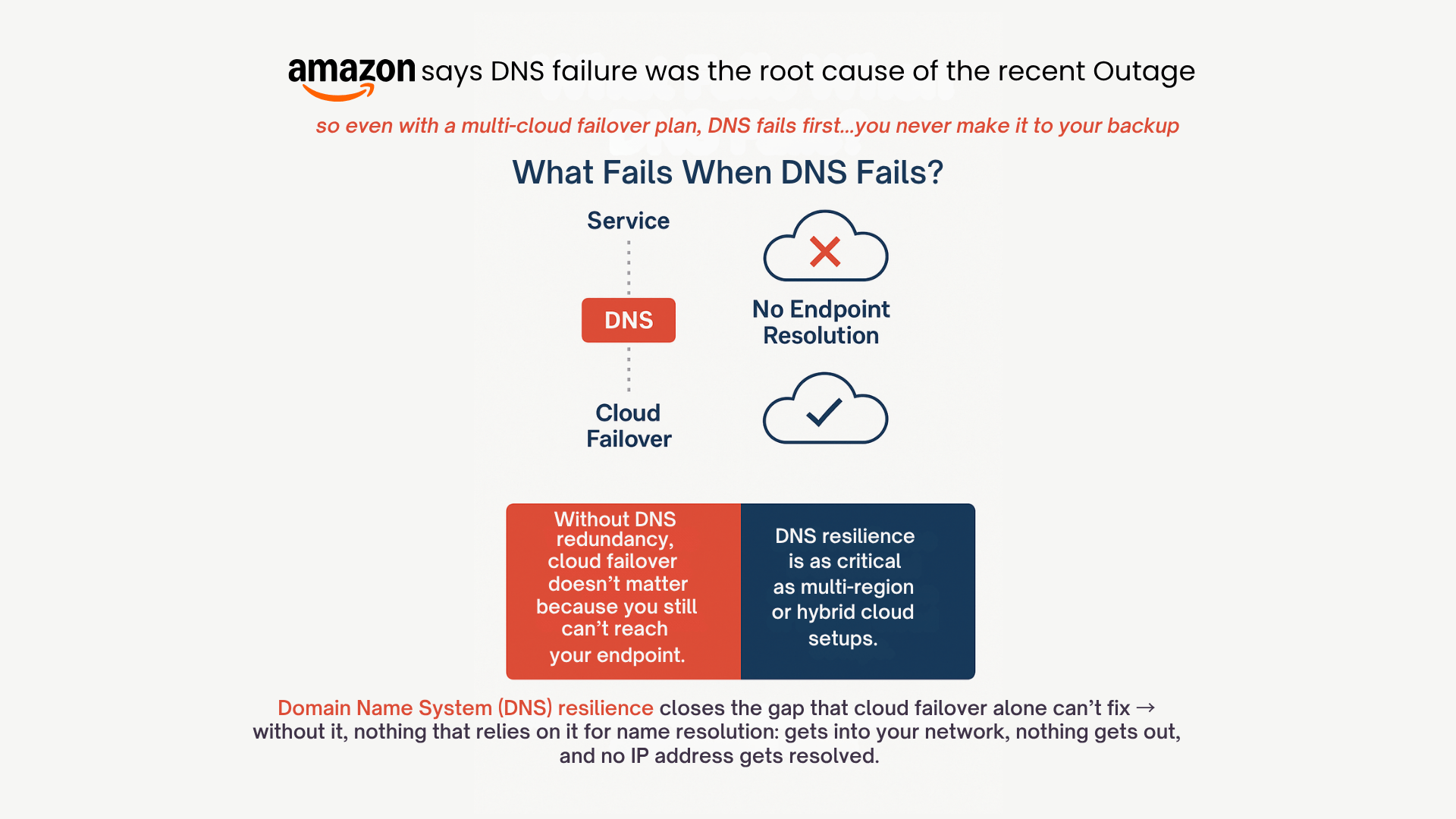
If DNS was the root cause behind Monday’s AWS outage, then even having multi-region failover or hybrid cloud setups wouldn’t save you…unless DNS redundancy was built into the architecture from the jump.
Here is some more food for thought:
If your DNS provider is centralized, like using only Amazon Route 53 or Google Cloud DNS, and it fails, you’re toast. It doesn’t matter if your services are running in 10 regions or across AWS, Azure, and GCP. If nobody can resolve your endpoints, they can’t reach your app. Period.
And it goes deeper:
- If your apps rely on internal service discovery or routing mechanisms that also go down when DNS is impacted, your failover won’t matter.
- If your client-facing front ends (websites, APIs) are hardcoded to resolve names via affected services, even healthy backend systems become unreachable.
- If you don’t have a secondary or federated DNS layer, like Cloudflare, NS1, or edge-based fallback via a CDN, you’re at risk.
- And if your DNS TTL settings or client-side fallback logic aren’t tuned, there’s no buffer to absorb the impact.
This is why DNS needs to be treated as a first-class architectural consideration.
What helps in these scenarios:
- Independent or federated DNS failover (e.g., a secondary registrar/DNS provider or edge-routing like Cloudflare with fallback rules)
- Aggressive DNS caching with appropriate TTL strategies
- Client-side fallback logic when applicable (especially tricky with mobile apps or embedded systems)
- Anycast networks that can reroute requests before they hit the broken resolver path
So, it’s critical you understand this is not only a resiliency checkbox issue…it’s a foundational architecture gap. Because even if your infrastructure is built for failover, it won’t matter if the name resolution layer breaks down first and there is no fallback for it.
🧩 Follow me, Kaylaa T. Blackwell and subscribe to ByteCircuit for more tech breakdowns that help you connect the dots.
I originally wrote and published my thoughts on LinkedIn regarding this problem, Wednesday Oct. 22nd, following the AWS outage on October 20, 2025. See the link to the active conversation going on there based on this post, in case you want to join in there: https://www.linkedin.com/posts/kaylaablackwell_aws-dns-cloudcomputing-activity-7386819691253542912-M44i