
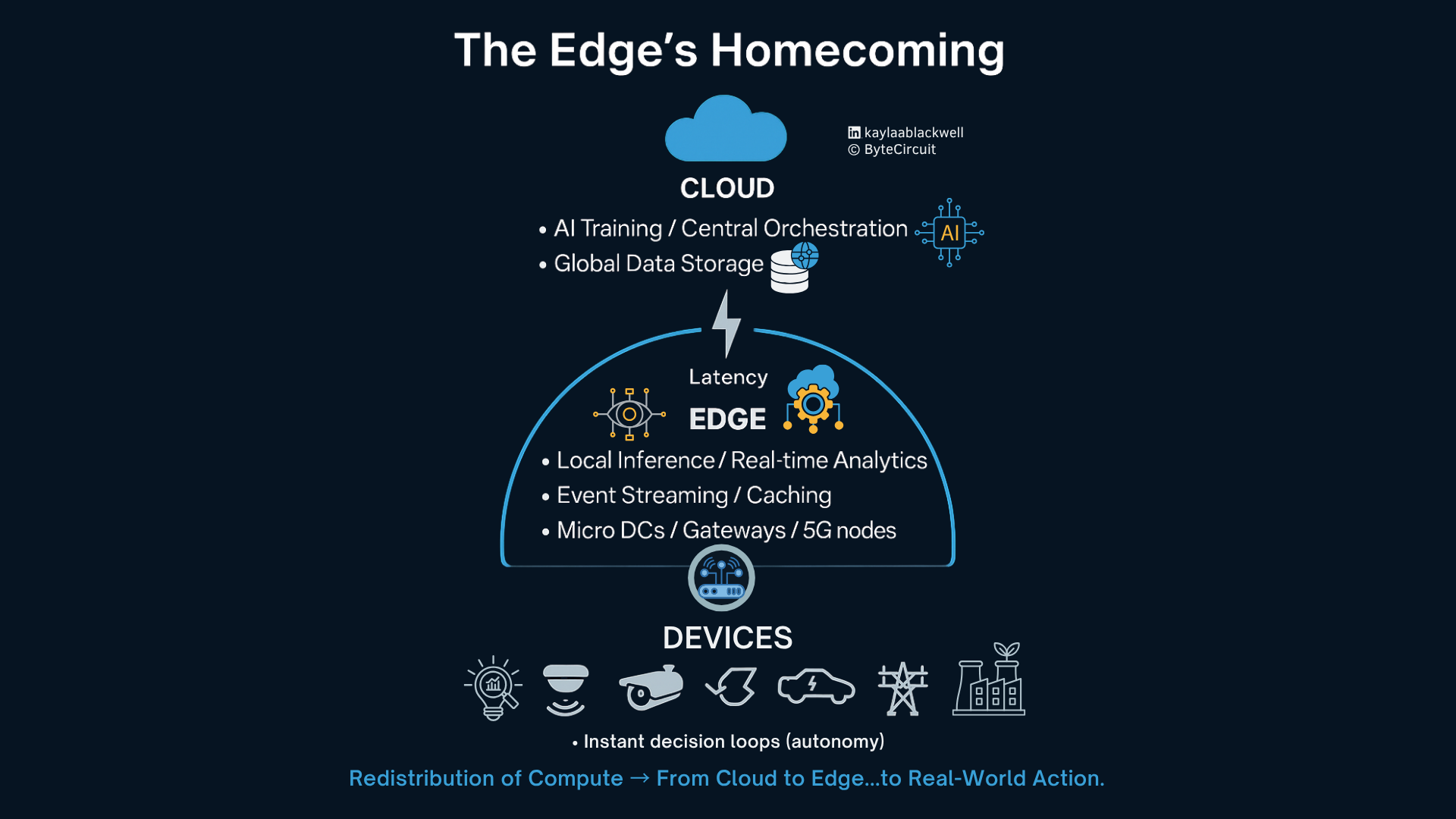
After a decade of chasing scale in the cloud, compute has found its way back to the edge.
For years, we’ve talked about the cloud like it was the final destination…the place where compute, storage, and intelligence would eventually live. But that model is reaching its limit. With the mad rush of 2025, we’re watching the opposite happen…compute is coming home.
The edge, once treated like the cloud’s outer fence, is becoming the center of gravity for AI workloads, real-time analytics, and low-latency services. The race now focuses on shrinking intelligence and placing it where decisions actually happen, not just the building of bigger data centers.
1. The Shift Is Already Here
In the last quarter alone, Nvidia, Microsoft, Amazon, and Apple each made quiet but defining moves:
- Nvidia introduced Jetson Thor and Grace Hopper chips that bring AI inference closer to sensors and robots.
- AWS expanded Local Zones and Wavelength to blend cloud regions with telecom infrastructure.
- Microsoft announced Azure Operator Nexus, a distributed fabric designed to host workloads inside 5G and enterprise networks.
- Apple placed AI inference directly on iPhones under “Apple Intelligence,” changing or redefining rather, how we think about on-device privacy and latency.
Each move signals the same thing…the edge is no longer an accessory, it now defines the architecture.
2. The Centralized Model Has Expired
Or maybe that’s too absolute, so I’ll just say the old model is breaking down. In that, the traditional cloud model was built for scale, not proximity. So data traveled thousands of miles for decisions that needed to happen in milliseconds. And while that model works for analytics, it fails for autonomy because trust depends on instant responses.
Self-driving vehicles, grid operations, industrial control systems, and real-time personalization can’t wait for round trips to centralized regions.
Because even a few hundred milliseconds can break synchronization and trust or cause a safety risk and lead to failures.
So the problem is no longer a capacity or bandwidth issue…the limit is physics…and physics always wins.
3. Intelligence Is Moving Outward
We’re entering what I call the dispersed intelligence era…where compute, storage, and AI inference are being embedded directly into edge nodes, devices, and even network layers. This is not decentralization for buzzword’s sake, it’s optimization driven by necessity. It looks more like the evolution of system design to meet the speed and reliability demands of the physical world.
A camera that can pre-process video, a drone that can self-navigate without uplink, a substation that can self-heal a fault and restore power using local inference…these are now more than prototypes. They’re the early proof of a global architectural inversion being driven by the reality that intelligence now lives where action happens.
4. Design Principles for the New Edge
Enterprises that want to stay relevant need to design differently:
➡️ Architect for autonomy, not dependency.
Edge nodes must operate even if the cloud connection is lost. That means designing systems with local decision logic, caching, and fallback models so operations continue during network disruptions.
In practice, this could include distributed control planes, edge-resident inference models, and event streaming platforms like Apache Kafka or Pub/Sub that maintain state even when upstream links drop.
➡️ Build local trust models.
Identity, policy, and telemetry have to live closer to the data source.
For traditional IAM frameworks that depend on centralized validation won’t scale across millions of distributed endpoints.
Therefore, zero-trust principles must extend to the edge itself, embedding encryption, attestation, and anomaly detection within the local fabric to ensure decisions are still visible and verifiable, even when offline.
➡️ Treat the network as a compute layer.
Switches, routers, and gateways are becoming intelligent intermediaries, instead of being only traffic cops.
Hence, modern architectures are embedding lightweight inference and filtering directly into the network path using programmable data planes, smart NICs, and in-network processing to reduce latency and bandwidth strain while improving context-aware routing.
➡️ Simplify the middle where orchestration lives.
The more we distribute intelligence outward, the more orchestration and control layers must dissolve into adaptive fabrics. Think Kubernetes at the edge, service mesh federation, or cross-cloud extensions like Azure Arc, Anthos, and AWS Outposts that localize decision-making while maintaining policy coherence.
5. The Future Is Hybrid by Default or Hybrid in Motion (based on your unique vantage point)
But based on current trends, the next couple of years’ architecture won’t be cloud or edge…it’ll be both.
Rest assured, the goal is not abandoning the cloud or overrunning the edge…it’s finally using them for what they do best:
☁️ Cloud will remain the training ground for large models and global orchestration to manage the learnings.
⚙️ Edge will handle inference, autonomy, and response to handle the doings.
💡 The Bigger Picture
Embrace the edge…not as the end of cloud computing, but the return of computing to the real world.
Also, don’t look at the edge as a new frontier…it’s more like a correction.
We’re not moving backward from the cloud…we’re just redistributing intelligence to where it was always meant to live…closer to people, machines, and moments that matter.
🧩 Follow me, Kaylaa T. Blackwell and subscribe to ByteCircuit for more tech breakdowns that help you connect the dots.