
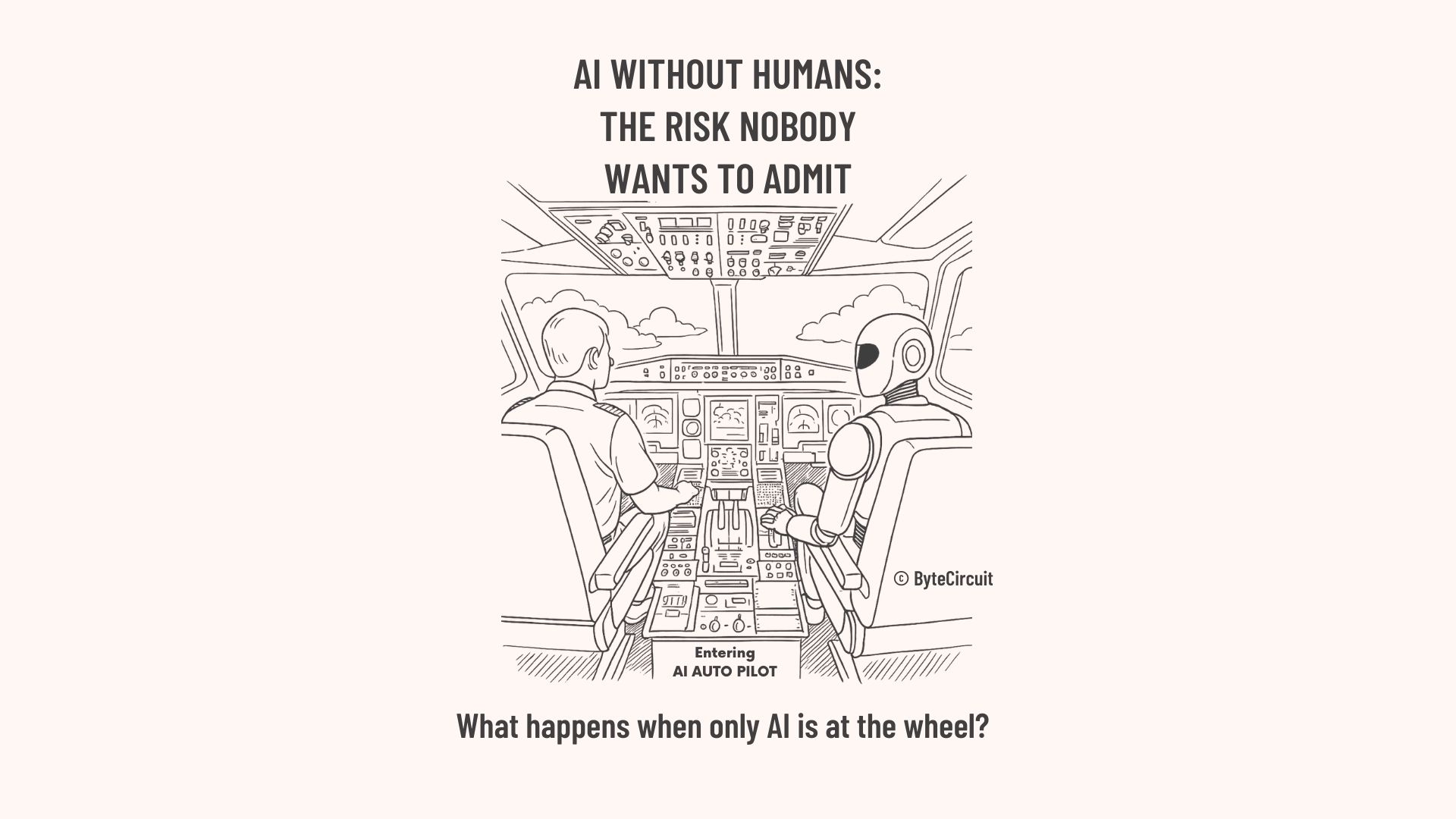
Everyone is worried about AI taking jobs. The bigger danger is AI taking judgment.
In critical systems like the energy grid that powers millions of homes, hospitals, or even aviation, efficiency pushes are quietly removing humans from the loop. On paper, it looks logical because algorithms do not tire, they optimize faster, and they do not get distracted by office politics, especially the kind fueled by passive-aggressive emails and free donuts in the breakroom. But when human oversight gets stripped away, the qualities that hold systems together such as accountability, empathy, and contextual judgment also disappear. That is when efficiency turns into something fragile.
Where Judgment Already Protects Us
Aviation figured this out decades ago. For example, planes are loaded with automation, but regulators like the NTSB require “meaningful human control” because a fully automated cockpit is a recipe for cascading failures when anomalies hit. So, pilots are trained not only to push buttons but to take command when sensors conflict or the system cannot reconcile reality.
Healthcare is another reminder. AI diagnostics are advancing fast, but studies from The Lancet Digital Health and JAMA Network Open show clinicians override machine diagnostic tools and their recommendations when stakes are high.
- For example, a 2025 randomized trial in The Lancet Digital Health tested a diagnostic decision support system and found that while it broadened differential diagnoses, clinicians still applied human judgment to overrule suggestions when context demanded it (Hautz WE, et al., 2025).
- A systematic review in JAMA Network Open (Vasey B, et al., 2021) covering 37 studies found little robust evidence that machine learning tools consistently improved diagnostic accuracy, and noted clinicians often rejected algorithmic advice in high-stakes cases.
So, it is not for the sake of stubbornness when doctors push back with this. If you are the one signing the death certificate, accountability does not disappear because a model shows “95% confidence.” You are accountable for the outcome, plus you are carrying responsibility for the patient, the family, and the trust that the system depends on. Therefore, a probability score does not remove that weight.
Utilities face the same line. The U.S. power sector runs under NERC and FERC reliability standards that require humans in the loop. If an optimization system miscalculates and executes at machine speed, millions could go dark in seconds. Consequently, grid operators are not there as window dressing; they are there because judgment under uncertainty is something AI still cannot do.
These examples drive home the point: automation amplifies, but judgment governs.
What’s the Easy Trap?
Leaders see speed and cost savings and start to think: why not just let the AI decide? First it is “AI assists humans.” Then it is “humans supervise AI.” Then suddenly the humans are really just rubber stamps and the system is flying solo.
That slide is dangerous for a lot of reasons. We have already seen it in financial markets, where high-frequency trading algorithms triggered flash crashes nobody fully understood in the moment, like the 2010 “Flash Crash,” when $1 trillion in market value evaporated in minutes before partially recovering. Or in 2022, when a Citigroup trader’s fat-finger error accidentally placed orders worth $444 billion, which cascaded through automated systems and briefly roiled European markets before being caught. Yes, efficiency is seductive until it backfires, and then everyone scrambles to explain why no one was really steering.
In the utility world, it would be like letting an optimization model balance the grid in a heatwave without human input. Sure, the math checks out, but what if it prioritizes industrial loads over residential cooling because the numbers say it is more “efficient”? Or take an outage response. An AI might calculate the fastest path to restore maximum load, but the neighborhood left for last could be full of vulnerable households, including people who rely on medical equipment and cannot afford to wait. That is more than an optimization problem. It is a human judgment call with life and death consequences that the algorithm simply does not see.
Judgment Is Not Only Decision-Making
People think judgment means picking option A or B. It is a lot more than that. Judgment is responsibility. It is empathy. It is the ability to weigh consequences that do not fit neatly into a dataset.
AI optimizes for outcomes. Responsible humans judge based on values, nuances, expertise, experience, and situational awareness that optimize the outcomes. Those are not the same thing.
That’s why replacing judgment with automation instead of using automation to augment judgment is more dangerous than replacing routine tasks. The task is about execution. Judgment is about meaning. Lose that and you are not running a system; the system is running you.
The Leadership Imperative
Governments are already drawing the line. The EU AI Act mandates human oversight in “high-risk systems” like healthcare, critical infrastructure, and justice. Aviation and power sectors enforce human-in-the-loop standards for good reasons.
But policy only goes so far. As leaders we need to resist the temptation to equate efficiency with progress. Shaving a few seconds off a process is not worth it if you are also shaving off accountability.
This is not anti-AI or anti-automation; it is about balance. AI can help with the heavy lifting of analyzing patterns, simulating scenarios, and surfacing recommendations. But throughout the process, human guidance and oversight remain critical because the final mile of judgment belongs to us. Though we are still quite flawed, we bring accountability, empathy, and adaptive responsiveness that no algorithm can replicate.
And let us be honest. Most catastrophic failures in complex systems do not come from lack of speed. They come from bad data, incorrect assumptions, ignored warnings, or missing context. AI will not fix that by itself.
Practice Makes Resilient
The most dangerous future is not AI replacing jobs. It is leaders letting AI replace judgment.
That means the real skill leaders need to practice is not how to automate more. It is how to design systems where AI augments human responsibility instead of erasing it. It is not glamorous. But resilience comes with a lot of practice.
The leaders who get this right will create organizations that are both fast and accountable, efficient and humane. While everyone else will be left hoping their AI decisions do not end up in a post-mortem report.
Sources & Further Reading
- Hautz WE, et al. Diagnoses supported by a computerised diagnostic support system (DDX-BRO trial): a randomised controlled trial. The Lancet Digital Health. 2025.
https://doi.org/10.1016/S2589-7500(24)00250-4 - Vasey B, et al. Association of Clinician Diagnostic Performance With Machine Learning–Based Clinical Decision Support Systems: A Systematic Review. JAMA Network Open. 2021;4(3):e213287.
https://doi.org/10.1001/jamanetworkopen.2021.3287 - Goh E, et al. Effect of Large Language Models on Diagnostic Reasoning by Physicians: A Randomized Clinical Trial. JAMA Network Open. 2024;7(7):e2421170.
https://doi.org/10.1001/jamanetworkopen.2024.21170
🧩 Follow Kaylaa T. Blackwell on LinkedIn and subscribe here to ByteCircuit for more tech, critical infrastructure and the future-of-work breakdowns that help you connect the dots.