
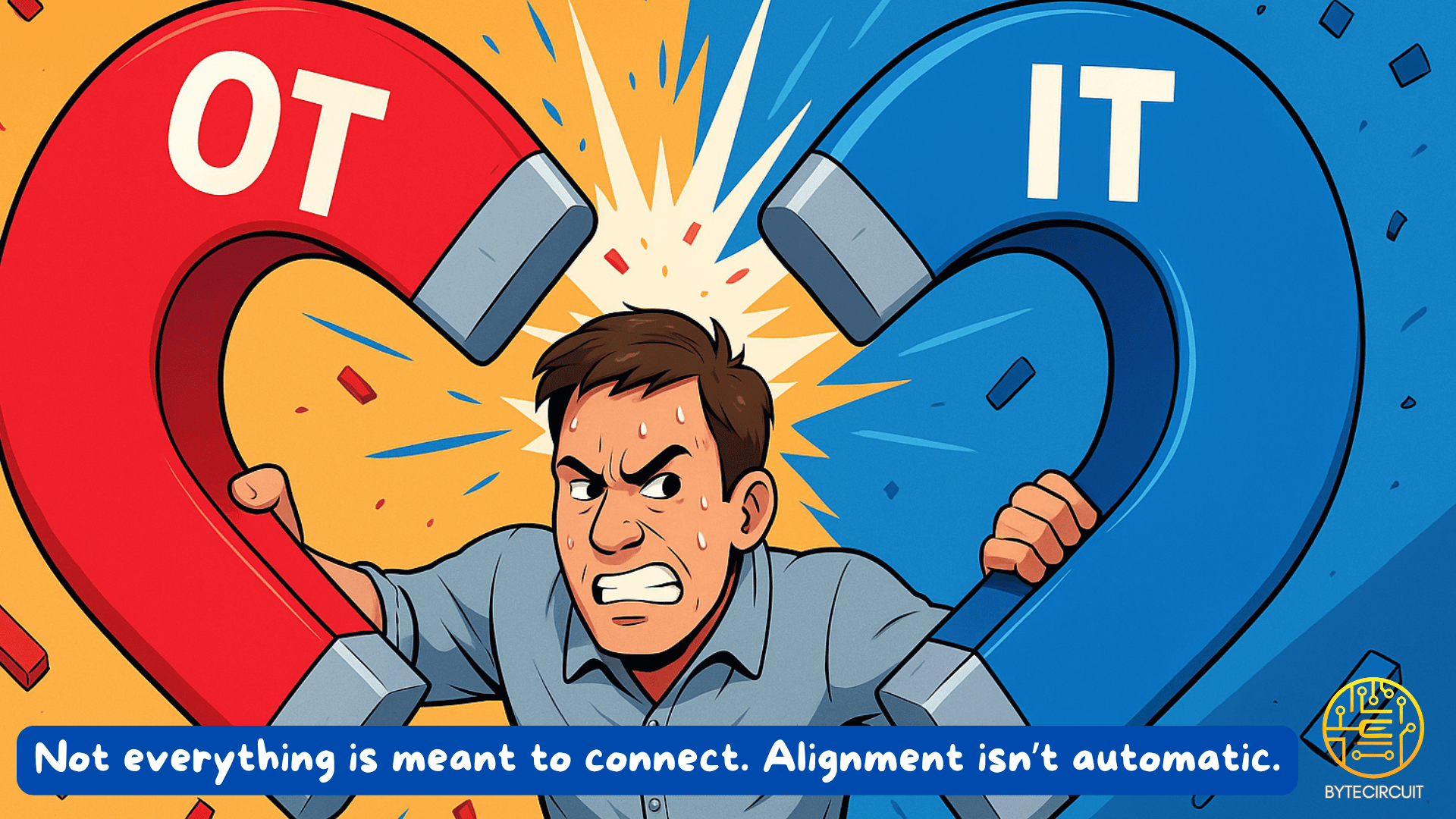
Modernization isn’t neutral. It’s either making your systems smarter… or making them vulnerable.
The most overlooked line in digital transformation isn’t about cloud or AI. It’s the line between IT and OT and too many orgs are stepping over it blindly.
Operational systems aren’t apps. They don’t crash quietly. They don’t fail safely. And they don’t come with a “restore from cloud” button.
In infrastructure, when things go dark…they go dark for real.
🧩 The Fault Line Few Want to Acknowledge
There’s a fundamental difference between managing data in the cloud and running power through a substation. Between deploying SaaS and stabilizing a smart factory. Between launching a new platform and operating a critical grid system.
Yet across the board, we see enterprise IT roadmaps being copied and pasted into OT environments, where downtime doesn’t mean lost productivity…it means lost trust, and sometimes lost safety.
OT isn’t a legacy layer. It’s a system discipline with its own logic, risk model, and regulatory backbone. If you treat it like IT, you’re not innovating…you’re destabilizing.
🧩 The Cloud Pitch That Didn’t Land
One time, a major cloud provider came in to pitch their Distributed Cloud solution for T&D systems. On paper, it was strong. Real-time processing, edge-to-cloud flexibility, AI-powered insights.
But when the questions hit the table→What happens if connectivity drops? What about NERC CIP? The energy in the room shifted and they were looking at us like we had horns growing out of our heads.
Because the answer wasn’t there.
The whole proposal assumed full-time external access and high-availability uplinks. That’s not how secure grid environments operate. That’s how PowerPoint operates.
I’ve also seen internal teams rush to drop millions on grid-edge platforms without understanding the compliance implications. One lead from another part of the business that was apart of the fandom literally said, “We don’t have to worry about that now.” But that right there, my friend, is how money and credibility vanish together.
🧩Quick Gut Check:
📍 Before adopting any cloud solution in an OT environment, confirm three things:
- Can it operate locally and autonomously when disconnected?
- Does it align with physical-layer segmentation and NERC/ISO standards?
- Can you prove, not just promise, secure failover and recovery?
If the answer to any of those is “we’ll look into it” → you’re not ready.
🧩 Critical Infrastructure Carries Its Own Weight
When you’re working in grid systems, substations, or industrial automation, OT is the backbone. These aren’t consumer tools. They’re lifelines: interconnected, regulated, and constantly under pressure.
You can’t cloudify your way around that.
Every architecture decision has to account for uptime, segmentation, auditability, and recovery. Because entire communities are connected to what gets built behind the scenes.
While manufacturing often dominates the Industry 4.0 spotlight, critical infrastructure has even less margin for error. The stakes are higher. The buffers are smaller. And the transformation must be grounded in resilience first.
🧩 Smart Manufacturing Knows Where the Lines Are
Smart factories already know the game. Connectivity matters…but not at the cost of uptime or process control.
That’s why the smartest players focus on segmentation, edge processing, and clear IT/OT boundaries. That’s not resistance → it’s reality.
In my own work across smart manufacturing, utilities, and critical infrastructure, we’ve modernized systems while still honoring the physical limitations and compliance layers that protect everything behind the curtain.
Architectures we’ve built span edge devices, SCADA, telemetry pipelines, and AI observability, all stitched together not for trend…but for trust.
🧩 Modernization Without Recklessness
Transformation isn’t about replacing the old with the new. It’s about asking what the new needs to respect.
Hybrid cloud, digital twins, AI workloads are reshaping how we operate. But we can’t treat OT like a software stack. Some things need to stay on-prem. Some data has gravity. Some systems are safer when left alone.
That’s not stubbornness. That’s responsible architecture.
⚡The Power of Hybrid Thinking
Innovation doesn’t happen in silos. It happens in the tension zones, at the firewalls, the protocol mismatches, the regulatory constraints, where you’re forced to balance risk with reward.
The best architects I’ve worked with don’t just chase transformation. They translate it…knowing when to connect and when to contain…when to accelerate and when to anchor.
Because some systems need trust before transformation. And some boundaries aren’t barriers→they’re wisdom in disguise.
📌 Download the checklist: Before You Cloudify OT: 5 Checks That Could Save You Millions
🧩 Found this helpful?
♻️ Share it to help others save time, budget, and their next deployment.
👉🏽 Follow Kaylaa T. Blackwell and sign up for ByteCircuit newsletter for ongoing insights into strategic leadership, innovation, and building smarter, scalable systems—by design, not default.
📘 P.S. Want a no-fluff entry point into Python? Sign up here for early access and sneak peeks of Kaylaa’s upcoming book:
Crack the Code: Python Byte by Byte—A Playbook to Learning Python Fast Without Fear, Frustration, or Tears.