
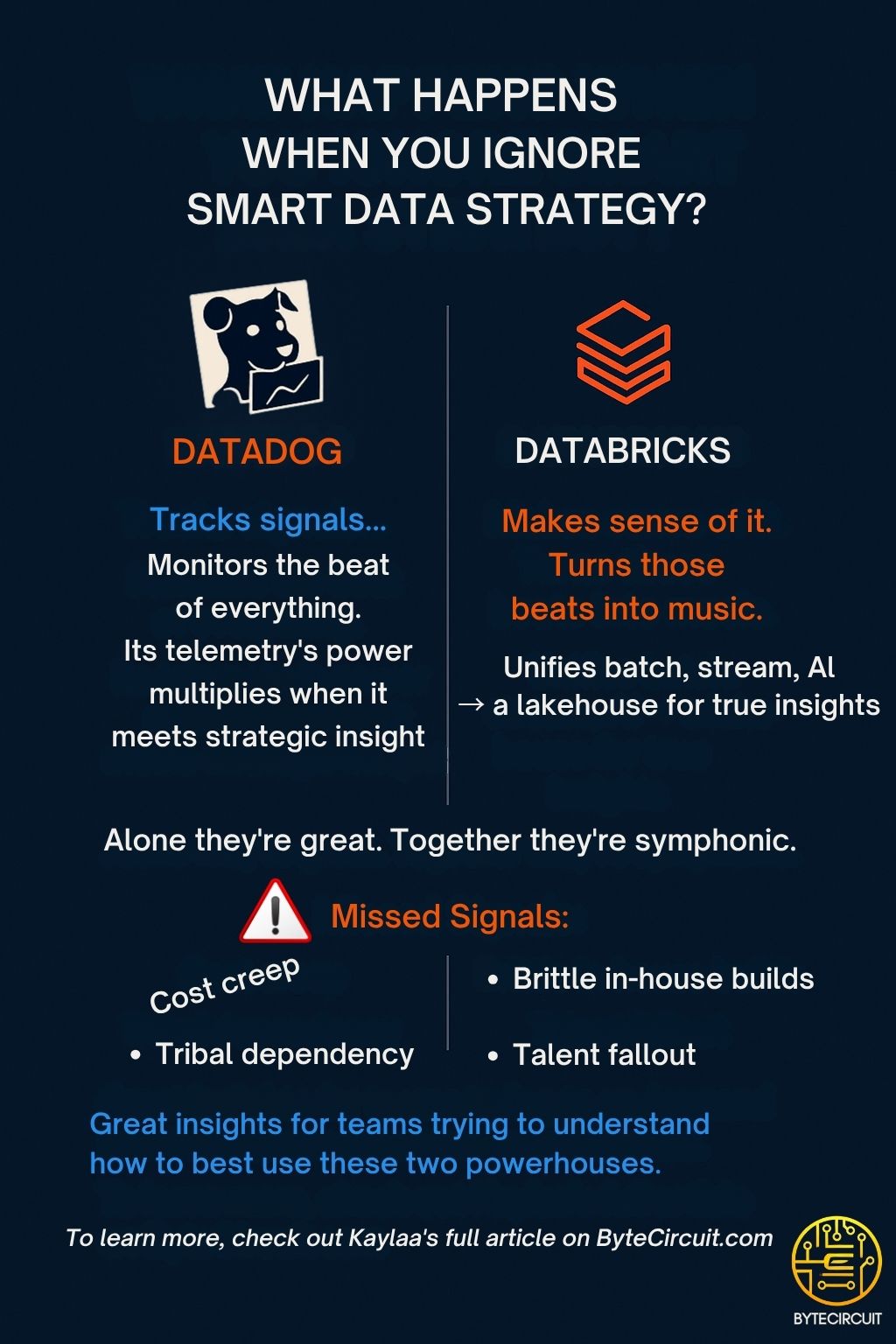
Once upon a real-time log stream…
There was a company (maybe yours), with dashboards glowing, alerts firing, and engineers pinging each other in ALL CAPS.
They had DataDog, so they were great at observability. Oh yes.
Everything was being watched.
But nothing was being understood.
Because they were missing the strategy engine.
One platform tracked signals…
But there was no system for making sense of it all.
So, someone quietly pitched Databricks.
Maybe it was you.
Or that could’ve been me.
We tried to explain how it could unify batch, stream, AI, and insight.
Showed how a lakehouse strategy could translate telemetry into business outcomes.
They listened politely or more like with bothered impatience.
Then they shelved it.
Why?
Because the loudest voices were too busy being important to be curious or listen to reason.
1. So What’s the Difference Between Databricks & DataDog?
- Databricks is a platform for data engineering, analytics, and machine learning.
It brings structure to your data lake—letting teams build pipelines, transform data, and train models all in one place. - DataDog is an observability and monitoring platform.
It’s built for logging, tracing, metrics, and visualizing the health of your infrastructure and applications.
Think of it this way:
DataDog shows you that something happened (and where).
Databricks helps you figure out why it happened—and what to do next.
2. Why They Work Better Together
- DataDog gives you the pulse of your system. Real-time logs, metrics, and alerts.
- Databricks lets you ingest, clean, enrich, and analyze that data at scale.
When connected, they create a smart feedback loop:
- DataDog detects a spike in latency.
- Raw log data is fed into Databricks.
- Databricks runs ML models to find patterns over time.
- Insights feed back into engineering, product, or ops.
That’s how you move from observing symptoms
→ to understanding root causes
→ to predictive engineering.
3. What Could’ve Been
In our little tale…
No one had time to think about the long game.
They kept adding tools with sexy names…which is always nice.
But there were no real deliverables…so these weren’t sexy at all just pure mimicry.
Not realizing they were building a stack with no spine.
So they missed signals.
Yep…the really important ones.
And spent millions.
Eventually, the org did change.
But not before losing talent, trust, and time.
Don’t be that team.
Or the one that gets scapegoated or kicked in the teeth because
you let the loudest voice drown you out—
though it’s your job to speak some sense into the nonsense.
Databricks vs DataDog: Strategic Tech Comparison
| Category | Databricks | DataDog |
| Primary Focus | Data Engineering & AI | Monitoring & Observability |
| What It Does | Processes structured & unstructured data for analytics and ML | Tracks logs, metrics, traces, and system health in real time |
| Best Use Case | ETL, data pipelines, batch & streaming processing, AI/ML modeling | Monitoring infrastructure, app health, alerts, dashboards |
| Strengths | Unified lakehouse, scalable ML, powerful notebooks, open format support | Real-time alerts, visual dashboards, system-wide observability |
| Limitations | Not a monitoring tool; requires observability integration | Not built for deep analytics or ML modeling |
| When Used Together | Transforms raw logs into actionable insights; supports predictive strategies when used with DataDog | Feeds live telemetry to Databricks to analyze trends and automate action |
🧩 Why You Shouldn’t Build In-House When Databricks Already Exists
🛑 At one point while telling the said leadership about Databricks, they floated the idea of building their own in-house platform instead of using Databricks.
In the echo, it sounded “innovative.” But in reality, it was a recipe for cost creep, tribal dependency, and future rework.
🚫 Why Reinvent the Wheel? When Not to Build In-House (vs. Using Databricks)
| Criteria | In-House Platform | Databricks |
| Time to Value | Long. Internal dev cycles + limited resourcing = slow delivery. | Fast. Built-in tooling and optimized runtimes accelerate delivery. |
| Team Dependency | High. If staff leaves, tribal knowledge disappears. | Low. Continuity through managed services, documentation, and support. |
| Cost Over Time | Hidden creep. Dev time, bug fixes, re-architecting. | Transparent. Pay-as-you-go pricing with scale economics. |
| Feature Depth | Limited. Hard to match full ML/streaming/AI stack. | Deep. Unified platform for AI, ML, BI, streaming, and batch. |
| Security & Compliance | Risk of gaps unless baked in. | Enterprise-grade, with SOC 2, HIPAA, FedRAMP, etc. |
| Innovation Velocity | Slower. Teams focus on fixing instead of innovating. | Faster. Built-in updates, libraries, and integration ecosystem. |
| Scalability | Often brittle or hard-coded to specific infra. | Elastic scaling across cloud with native Spark optimization. |
💡 Byte For Thought:
If your stack doesn’t align strategy with telemetry…
You’re not data-driven.
You’re just dashboard-addicted.
Databricks and DataDog are powerful alone.
But together?
They are symphonic and help orgs not just see what’s happening—
but understand and evolve.
🧩 Pro tip:
Don’t wait for chaos to trigger your strategy.
Build it now.
Before the fire alarm goes off.